
When people search for Alexander Esters, they may encounter more than one person with the same name. One is a German contemporary artist born in 1977 in Bad Kreuznach, known for painting, sculpture, drawing, and glasswork. Another Alexander Esters has worked in occupational safety and logistics, including a professional role at DACHSER in Kempten.
The artist is the more prominent cultural figure associated with the exact name. His career connects traditional artistic disciplines with unusual combinations of form, color, materials, and spatial ideas. His work has appeared in galleries, museums, exhibitions, and auctions, while his artistic education included study at the Johannes Gutenberg University of Mainz and the Kunstakademie Düsseldorf.
What makes Alexander Esters interesting is not simply the range of media he has used. His work reflects an ongoing interest in how familiar shapes can become strange, abstract, playful, or dreamlike when transformed through painting and sculpture.
His career also includes teaching and participation in exhibitions across Germany and beyond. By looking at his education, artistic language, exhibitions, and known works, it becomes easier to understand why Alexander Esters has attracted attention within German contemporary art.
Who Is Alexander Esters?
Alexander Esters is a German contemporary artist born in 1977 in Bad Kreuznach. His artistic practice includes painting, sculpture, drawing, and stained glass, giving his work a broader material range than a conventional painting-only practice.
Available art records describe Esters as a postwar and contemporary artist, while exhibition databases document solo and group exhibitions involving his work. Artist-info records, for example, list ten exhibitions between 2002 and 2012, including presentations at museums and art institutions in Germany.
His work has also appeared in auction records. MutualArt lists several works by Esters that have been offered at auction, including Baum der Kenntnis, which achieved a reported auction price of $1,673 in 2021.
Esters is particularly interesting because his artistic vocabulary does not remain inside a single medium. Painting forms the foundation of his practice, but sculpture, drawing, and glasswork allow him to explore similar ideas through different physical structures.
The Institut für Kunstdokumentation und Szenografie describes him as part of a newer generation of artists strongly concerned with form and color. It also characterizes his painting as developing ideas associated with Surrealism and Cubism into a distinctive visual language.
That combination gives his work a recognizable position within contemporary German art.
Alexander Esters Education and Early Career
Esters developed his artistic background through formal study in Germany. Biographical records state that he studied fine art, philosophy, and art history at Johannes Gutenberg University Mainz, eventually concentrating on painting and fine art in the class of Friedemann Hahn.
His education was not limited to classroom study. Between 1998 and 2000, he worked as an assistant to the artist Lore Bert. He later worked with Friedemann Hahn and took on a tutoring role within the university’s art department.
In 2002, Esters received a scholarship from the Studienstiftung des deutschen Volkes and moved to the Kunstakademie Düsseldorf. There he studied in the class of Albert Oehlen, one of Germany’s best-known contemporary artists. Esters completed his studies in 2004 as Oehlen’s master student and received his academy qualification.
This period was important because Düsseldorf has long played a major role in German contemporary art. Studying there placed Esters within an environment associated with experimentation, painting, conceptual thinking, and debates about the possibilities of contemporary art.
His early professional development also included publishing. Biographical sources state that Esters worked with Cornelius Quabeck on the magazine Der Atom through their own RedmotA publishing venture.
By 2006, he had reached an important early milestone with his first solo gallery exhibition at Van Horn in Düsseldorf, where he presented large-format paintings and linocuts.
The Artistic Style of Alexander Esters
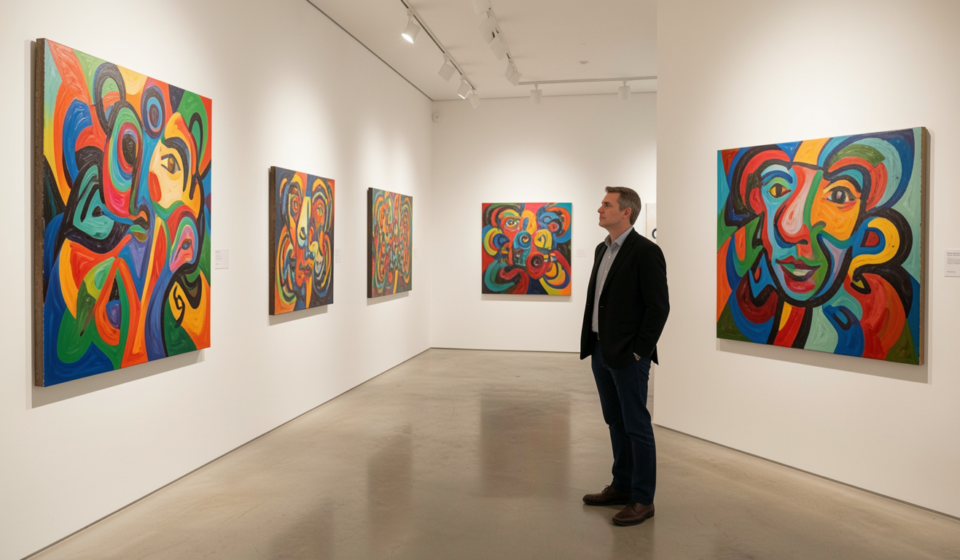
The art of Alexander Esters is difficult to place into one simple category. His paintings often combine recognizable forms with distortion, abstraction, unusual perspective, and dreamlike structures.
The Institut für Kunstdokumentation und Szenografie emphasizes his interest in form and color, describing his paintings as an evolution of ideas associated with Surrealism and Cubism.
That description helps explain why his work can feel familiar and unfamiliar at the same time.
A viewer may recognize a head, figure, object, architectural element, or natural form, yet the shape may be altered enough to create uncertainty. Instead of presenting an object exactly as it appears in ordinary life, Esters can transform it into something that feels more like a mental image.
This is one reason his paintings reward close observation.
His work also demonstrates an interest in the physical relationship between shape, surface, and space. Sculpture allows him to take ideas that exist within a two-dimensional painting and give them physical presence.
Glasswork creates another possibility. Stained glass has a long artistic history, but Esters uses the medium within a contemporary practice, allowing color and structure to interact with architecture and light.
His sculpture is equally varied. The Institut für Kunstdokumentation and Szenografie notes that he has combined modern materials with traditional stained-glass techniques. It also records a large-scale sculpture created for the Cologne Sculpture Park in 2009.
This mixture of old and new materials is an important part of understanding his artistic approach.
Major Works and Exhibitions
Alexander Esters has participated in exhibitions at galleries, museums, and art institutions in Germany and internationally.
One important exhibition was Kopf mit Dreht, presented at the Deutsches Glasmalerei-Museum in Linnich from March to April 2012. The same period also saw his work presented at the Leopold-Hoesch-Museum in Düren.
Earlier exhibitions included a solo presentation at the Kunstverein Langenhagen and appearances at other German cultural institutions. Artist-info records show that his exhibition history includes both solo and group presentations.
His work was also featured in the 2008 exhibition Size Matters: XXL at Hudson Valley MOCA in Peekskill, New York. MutualArt records additional exhibitions at Van Horn in Düsseldorf and FeldbuschWiesnerRudolph in Berlin.
One particularly notable work is Hitzeblick, am Ende die Tunnel, a 2009 relief associated with the Museum Baden. The work has been documented in art publications discussing Esters and the regional contemporary art scene.
Another work that appears in auction records is Baum der Kenntnis, created in 2006. It was offered at Van Ham Fine Art Auctions in Cologne in 2021 and became the artist’s highest reported auction result in the available MutualArt record.
Other recorded titles include Figur, Der Bilderstreit, Zeitreiser, Seeing thinks, and Akademie für Bedeutungsmalerei.
These titles alone show the conceptual and playful character that can appear throughout Esters’ work.
Painting, Sculpture and Glasswork
Although painting is central to Alexander Esters’ artistic identity, it is only one part of his wider practice.
His paintings are known for their interest in unusual forms, color relationships, and visual transformation. The influence of Cubism can be considered through his treatment of structure and multiple viewpoints, while the Surrealist connection appears through strange combinations and dreamlike imagery. The Institut für Kunstdokumentation specifically places his work in relation to these artistic traditions.
Sculpture allows Esters to extend these ideas into physical space.
A sculpture is not experienced only from one fixed viewpoint. The viewer moves around it, sees different surfaces, notices shadows, and experiences its size in relation to the surrounding environment.
This makes sculpture a natural extension of an artist interested in form.
His use of stained glass is equally distinctive. Glass introduces light as an active part of the artwork. Color can change depending on illumination, surroundings, and viewing position.
Combining modern materials with traditional glass techniques creates a productive tension. It connects historical craft with contemporary artistic experimentation.
The result is an artistic practice that cannot be understood simply by looking at photographs of paintings. Esters’ broader body of work demonstrates an interest in how objects occupy space and how materials affect perception.
Alexander Esters in the Art Market
Alexander Esters has also developed a presence in the art market, with works appearing at auction and through galleries.
MutualArt records seven artworks and multiple auction results associated with the artist. Its available data reports realized prices ranging from $1,088 to $1,673, depending on the artwork, size, and medium.
The highest recorded result in that source is for Baum der Kenntnis, a 2006 work sold at Van Ham Fine Art Auctions in Cologne in 2021 for $1,673.
These figures should be interpreted carefully. Auction prices are not the same as a universal value for an artist’s work.
The price of a particular artwork can depend on:
- Medium
- Size
- Date of creation
- Condition
- Provenance
- Exhibition history
- Gallery representation
- Auction demand
- Market timing
A work with a strong exhibition history may attract a different level of interest from a less documented piece.
Collectors researching Alexander Esters should therefore examine the specific artwork rather than assuming that one auction result represents the entire market.
The presence of his work in museum exhibitions, galleries, and auctions nevertheless provides evidence that his practice has maintained visibility within the contemporary art ecosystem. Artist-info documents exhibitions at institutions including Museum Morsbroich, Kunstverein Langenhagen, and Deutsches Glasmalerei-Museum.
Alexander Esters as an Educator and Contemporary Artist
Esters’ career has also included teaching. Biographical sources state that since the beginning of 2011 he has worked as an art teacher at a gymnasium in Bad Sobernheim.
Teaching can add another dimension to an artist’s career. It requires explaining visual ideas, encouraging experimentation, and helping students understand how artists make decisions.
For an artist whose practice crosses painting, sculpture, drawing, and glasswork, that experience can be particularly valuable.
Esters’ career therefore combines several roles:
Artist: Creating paintings, sculptures, drawings, and glassworks.
Exhibitor: Showing work in galleries, museums, and group exhibitions.
Educator: Teaching art within the German school system.
Published artist: Appearing in catalogues, art publications, and documentation.
This combination provides a fuller picture than viewing him only through auction records.
His career also demonstrates how contemporary artists can build long-term practices without being restricted to a single medium or commercial market.
Alexander Esters in 2026
In 2026, Alexander Esters remains an interesting figure for anyone researching German contemporary painting and experimental visual art.
The available public record establishes his birth in 1977, his German background, his education in Mainz and Düsseldorf, and his work across painting, sculpture, drawing, and stained glass.
His exhibition history includes museums, galleries, and art institutions, while auction databases document a number of works that have entered the secondary market.
What stands out most is his commitment to form, color, transformation, and material experimentation.
Rather than treating painting as a simple representation of the visible world, Esters explores how recognizable subjects can be altered. His work can invite viewers to question what they are looking at and how their expectations shape their interpretation.
His use of sculpture and glass broadens that investigation.
The result is a body of work that sits comfortably within contemporary art while retaining visible connections to earlier movements such as Cubism and Surrealism.
It is also important to remember that not every online result for Alexander Esters refers to the artist. A separate professional named Alexander Esters works in occupational safety and has been associated with DACHSER in Kempten. DACHSER published a profile describing his work as a consultant in work safety and his involvement in making work processes safer.
For accurate research, checking the person’s profession, location, and field is essential.
For the artist, the strongest identifying details are his 1977 birth year, Bad Kreuznach birthplace, German contemporary art career, and multidisciplinary practice.
Frequently Asked Questions About Alexander Esters
Who is Alexander Esters?
Alexander Esters is a German contemporary artist born in 1977 in Bad Kreuznach. His work includes painting, sculpture, drawing, and stained glass.
What is Alexander Esters known for?
He is known for contemporary artwork focused on form, color, unusual visual structures, painting, sculpture, and glasswork. His work has been discussed in relation to Surrealism and Cubism.
Where did Alexander Esters study art?
He studied fine art, philosophy, and art history at Johannes Gutenberg University Mainz and later studied at the Kunstakademie Düsseldorf under Albert Oehlen.
What mediums does Alexander Esters use?
His practice includes painting, sculpture, drawing, linocut, and stained glass.
Has Alexander Esters exhibited in museums?
Yes. His exhibition history includes institutions such as the Museum Morsbroich, Leopold-Hoesch-Museum, and Deutsches Glasmalerei-Museum.
What is Alexander Esters’ most expensive known artwork?
MutualArt identifies Baum der Kenntnis, created in 2006, as his highest recorded auction result in its available data, with a reported price of $1,673 at Van Ham in 2021.
Is there another person named Alexander Esters?
Yes. A separate Alexander Esters has worked in occupational safety and logistics at DACHSER, so search results should be checked carefully before assuming they refer to the artist.
Where was Alexander Esters born?
The artist Alexander Esters was born in 1977 in Bad Kreuznach, Germany.
Read Also: CoAdvantage: Complete PEO and HR Services Guide for 2026